
Resistance bands are elastic strips or loops of varying thickness that provide variable resistance as you stretch them, and they are one of the most effective and practical tools older adults can use to maintain muscle strength, joint stability, and functional independence at home. Unlike free weights or machines at a gym, resistance bands are affordable, portable, require minimal space, and allow you to exercise safely with immediate control over how hard you’re working—you can instantly reduce tension by shortening the band or moving closer to the anchor point.
A person recovering from shoulder surgery, for example, can use a light band for gentle mobility work in their living room one week, then gradually progress to a heavier band as strength returns, all without leaving home or investing in expensive equipment. Resistance bands are not a replacement for physical therapy when injury or illness requires professional oversight, but they are a proven way to slow muscle loss, improve balance, reduce fall risk, and help you stay capable of doing the things that matter—opening jars, climbing stairs, getting out of a chair, and living independently longer. Research consistently shows that resistance training, even at light intensity, preserves muscle mass and bone density in older adults, and bands deliver that benefit with lower injury risk than weights because they move with your body and allow you to stop instantly if something doesn’t feel right.
Table of Contents
- What Types of Resistance Bands Work Best for Older Adults?
- Resistance Bands vs. Weights, Machines, and Bodyweight Exercises
- Key Exercises for Mobility, Balance, and Functional Strength
- How to Set Up a Safe Home Resistance Band Practice
- When Resistance Bands Aren’t Enough and When to Seek Professional Guidance
- Resistance Bands for Pain Management and Arthritis
- The Long-Term Role of Resistance Bands in Aging in Place
- Conclusion
What Types of Resistance Bands Work Best for Older Adults?
Resistance bands come in several forms, and choosing the right type matters for safety and effectiveness. Loop bands (also called closed-loop or therapy bands) are continuous circles of latex or fabric-covered latex, typically 12 to 41 inches in circumference and color-coded by resistance level—yellow is lightest, then red, green, blue, and black at the heaviest. Tube bands have handles at each end and resemble jump ropes, making them easier to grip if your hands are weak or arthritic; they’re good for pulling exercises like rows and chest presses. Flat bands are long strips without handles, offering more versatility because you can tie them, loop them around feet, or anchor them to a door frame.
For older adults new to resistance training, loop bands in light-to-medium resistance are typically the safest starting point because they’re simple to use, forgiving if you lose your grip, and cheaper to replace if they wear out. The color-coding and resistance level matter less than finding a band that allows you to complete 12 to 15 repetitions with good form while feeling challenged by the last few reps. Someone with arthritis in their hands might prefer a flat band they can loop around their foot or a tube band with padded handles, whereas someone with shoulder weakness might choose a loop band because it’s easier to anchor and adjust. A common mistake is buying too heavy a band because it seems more impressive—a band that’s too stiff often causes people to use poor form, brace their neck and shoulders, or skip the exercise altogether. Start light, focus on moving smoothly and controlled, and progress only when 15 reps feel easy.
Resistance Bands vs. Weights, Machines, and Bodyweight Exercises
Compared to dumbbells and barbells, resistance bands have real advantages for aging in place: they cost less ($5 to $30 for a quality band versus $100+ for adjustable dumbbells), take up almost no storage space, and create less noise if you live in an apartment or don’t want to disturb others. They’re also gentler on joints because the resistance increases gradually as you stretch—the hardest part of the movement (where you’re strongest) is also where the band is most taut, which feels more natural than the constant resistance of a fixed weight. However, bands have a limitation: resistance measurements are less precise, so tracking progress by “weight” doesn’t work the same way. Instead, you track success by doing more reps, adding extra loops of the band, or using a heavier color.
Compared to weight machines at a gym, bands require you to stabilize the resistance yourself, which engages more small stabilizer muscles and is actually more functional for real-world movement—getting out of a car or reaching into a high cabinet involves stabilizing muscles, not just prime movers. The downside is that bands require more attention to form because you can’t slouch into a machine. Compared to bodyweight exercises like squats and push-ups, bands add resistance at any fitness level; a person too weak to do even one wall push-up can use a band anchored to a door frame to get the same muscle activation with less body weight to control. For someone building strength after illness or injury, this scaling ability is critical.
Key Exercises for Mobility, Balance, and Functional Strength
The most valuable resistance band exercises for older adults target the muscles that prevent falls and keep you independent: the legs (quadriceps and glutes for stair climbing and chair rise), the back and shoulders (for posture, reaching, and fall prevention), and the core (for balance and spine stability). A simple but effective routine might include lateral walks (stepping sideways against band resistance to strengthen hips), chest presses anchored to a door at shoulder height (for pushing strength when reaching or defending against falls), and rows (for pulling strength and posture). These three exercises, done 2 to 3 times per week with 2 to 3 sets of 12 to 15 reps, can meaningfully improve functional strength in 4 to 6 weeks.
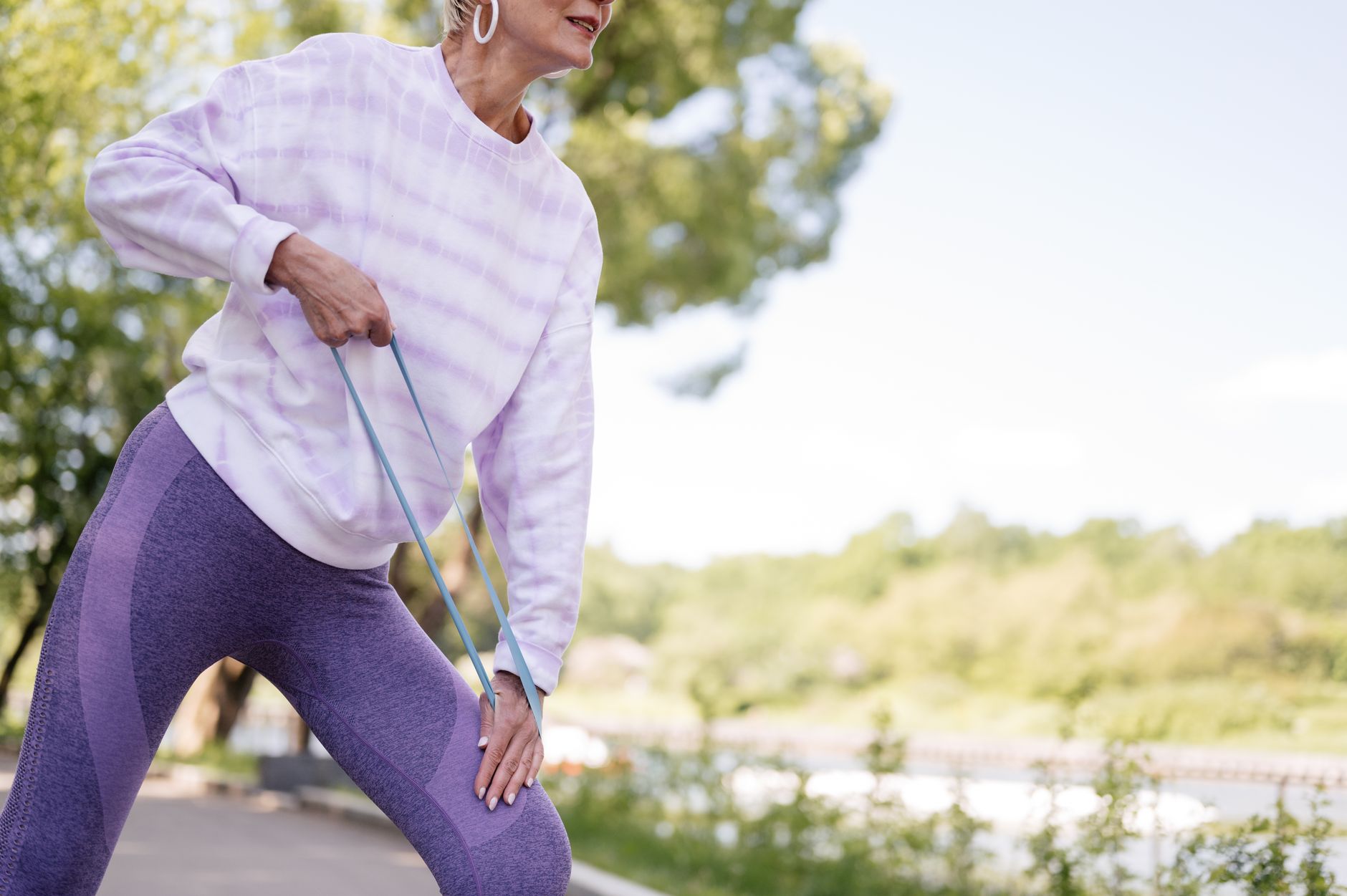
One specific example: an 78-year-old with early-stage arthritis in her knees struggled with stair climbing and felt unsteady. Using a light loop band around her thighs just above the knees for lateral walks, 15 reps, 3 times a week, she noticed improvement in stair climbing within three weeks and reported feeling more confident walking on uneven ground. The band strengthened the hip abductors (which stabilize the knee) without the impact of walking or squatting, which would have irritated her knees. This is the real-world power of bands: they allow targeted, low-impact strengthening of the exact muscles you need for independence.
How to Set Up a Safe Home Resistance Band Practice
Safety starts with anchoring the band securely if you’re using it for exercises that require pulling or pressing against resistance. A door anchor (a small plastic gadget that hooks over the top of a door frame) costs $5 to $10 and lets you anchor a band to any closed door at head height, chest height, or ankle height depending on the exercise. If you don’t have a door anchor, you can loop a flat band around a sturdy table leg or bedpost, or hold one end under your foot for downward pressing movements. The key is testing stability before putting your full effort into an exercise—give the anchor a sharp tug first to ensure it won’t slip or shift. Proper form matters more than resistance level.
Keep movements slow and controlled, taking about 2 seconds to stretch the band and 2 seconds to release—this tempo builds strength better than fast, bouncy movements and reduces injury risk. Never jerk or snap the band; if you feel yourself using momentum, the band is too heavy. If you have balance issues, stand near a sturdy support like a countertop or chair back, and do not hesitate to hold it with one hand while exercising. A practical trade-off: you’ll do fewer reps or use a lighter band if you’re holding a support, but the safety gain is worth it. The alternative—losing balance and falling while trying to prove independence—is far more damaging.
When Resistance Bands Aren’t Enough and When to Seek Professional Guidance
Resistance bands are tools for maintenance and gradual strength building, not treatment for pain or dysfunction caused by injury or disease. If you have recent joint surgery, severe arthritis, a diagnosed muscle tear, or pain that worsens with movement, start with guidance from a physical therapist, not a band you bought online. A therapist can show you which exercises are safe for your specific condition and help you progress safely. Similarly, if you have balance problems, neurological conditions, or fall risk, a therapist can design a band-based program tailored to your actual deficits, not a generic YouTube routine. A common mistake is assuming that if a light band is good, a heavier band is better—but overloading too quickly causes injury.
Signs that you’ve gone too heavy include sharp pain (not muscle fatigue), loss of form (using your back instead of your legs, swinging the band), or not being able to complete your reps while maintaining control. If any of these happen, drop back to a lighter band. Another limitation: bands wear out. Latex degrades over time, especially if exposed to sunlight or sharp temperature changes, so inspect your band before each use for cracks, discoloration, or loss of stretch. A worn band can snap suddenly under tension, which is dangerous if it’s near your face or a joint.

Resistance Bands for Pain Management and Arthritis
For people with arthritis, resistance bands are often more tolerable than weights because they provide variable resistance and don’t force your joint through a fixed range of motion. Someone with shoulder arthritis, for example, might not be able to do a press with a 10-pound dumbbell (the weight goes the same direction regardless of pain), but can do a band press at a slower speed, stopping short of the painful range, and still build strength in the pain-free zone. The band adapts to your available motion.
A specific example: a man with knee arthritis used a light resistance band for gentle knee extensions (straightening the leg against resistance) in the pain-free range. Over 8 weeks of 3-times-weekly exercise, his knee stability improved, his pain decreased (because stronger muscles support the joint better), and he needed his cane less often. This is not a cure, but it’s a concrete functional gain. Note: if arthritis pain is severe, always check with your doctor or physical therapist before starting any resistance program, as the wrong exercise can worsen inflammation.
The Long-Term Role of Resistance Bands in Aging in Place
Resistance bands are increasingly recognized in gerontology and aging-in-place research as a practical, low-cost intervention for maintaining functional independence in community-dwelling older adults. Unlike gym memberships or weight equipment that can feel intimidating or go unused, a $15 set of bands fits in a kitchen drawer and requires no special setup. As technology advances, some people now use apps or online coaching paired with bands, which can add structure and accountability without the cost or travel time of in-person classes.
The future of aging in place likely includes more hybrid approaches: a band-based home routine designed by a physical therapist, tracked via an app, with periodic check-ins via telehealth. The broader insight is that resistance bands fit the real constraints of aging in place: cost, space, accessibility, and the ability to exercise safely at home when mobility, transportation, or health limits access to a gym. They’re not fashionable, they won’t transform you, but they’re effective, affordable, and simple enough that someone in their 80s or 90s with arthritis, balance issues, or limited strength can use them every week for years.
Conclusion
Resistance bands are one of the most practical tools for maintaining strength, stability, and functional independence as you age at home. They work by providing variable resistance as you stretch them, cost little, take up no space, and allow you to progress at your own pace without the injury risk or cost of heavier equipment. Used 2 to 3 times per week with proper form, they can slow muscle loss, improve balance, reduce fall risk, and help you stay capable of the daily activities that matter—climbing stairs, opening jars, getting out of a chair, and living independently.
Start with a light band, focus on smooth, controlled movement, and progress slowly. If you have pain, recent injury, balance problems, or chronic disease, consult a physical therapist to ensure your band routine is safe for your situation. Resistance bands are not a substitute for professional care when needed, but they are a proven, accessible, affordable way to take active control of your strength and independence.